
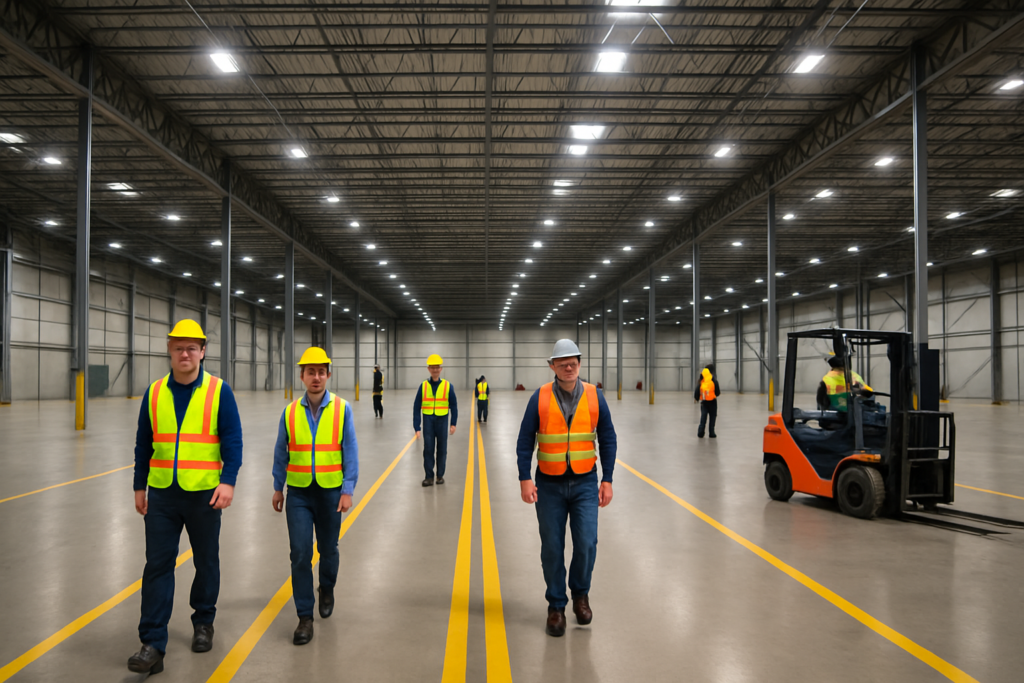
A warehouse safety checklist aligned with OSHA standards gives facility managers a structured way to identify hazards, document corrective actions, and reduce liability before an inspector arrives. Additionally, U.S. warehouses logged an injury rate of 4.8 per 100 full-time employees in 2024, more than double the 2.3 all-industry average, according to Warehouse Safety Statistics 2026: Risks & Prevention | OSHA Data. Therefore, implementing a warehouse safety checklist OSHA-compliant system is essential for every facility.
Table of Contents
- Why Warehouse Safety Is a High-Stakes Priority
- Core Elements of a Warehouse Safety Checklist
- OSHA Compliance Breakdown by Warehouse Safety Checklist Categories
- Things to Know
- Build a Culture That Sustains Compliance
- Request a Safety-Focused Warehouse Assessment
- Frequently Asked Questions
Key Takeaways
- U.S. warehouses have an injury rate more than double the national average, making documented safety protocols non-negotiable.
- Slips, trips, and falls account for 27% of all non-fatal warehouse injuries reported to OSHA (U.S. Bureau of Labor Statistics, 2023).
- OSHA penalties for serious violations reach $16,550 per violation as of January 2025. Willful or repeated violations reach $165,514.
- A structured warehouse safety checklist covers six core categories: housekeeping, material handling, fire safety, PPE, electrical hazards, and emergency preparedness.
- A 2025 industry survey found that safety ranks as the top concern for 84% of warehouse respondents.
- Facilities with integrated 3PL partnerships often benefit from built-in compliance frameworks that solo operators have to build from scratch.
Why Warehouse Safety Is a High-Stakes Priority
The numbers are hard to ignore. Transportation and warehousing recorded 232,000 injury and illness cases in the 2024 OSHA data. This makes it one of the highest-risk sectors in the U.S. economy. Moreover, a Department of Labor Inspector General report from September 2023 estimated that about 1.6 million workers across the nation’s roughly 20,000 warehouses face occupational safety challenges daily.
Financial exposure is equally serious. A U.S. Government Accountability Office report from September 2024 found that OSHA cited warehouse and last-mile delivery employers for more than 2,500 workplace violations. This occurred during fiscal years 2018 through 2023. As of January 2025, serious violations carry penalties of $16,550 per citation. In contrast, willful or repeated violations can reach $165,514 per violation. Those figures add up quickly across a multi-hazard facility.

For operators who want to understand how modern fulfillment environments structure their logistics, reviewing how 3pls support ecommerce order fulfillment at scale shows how built-in safety systems are woven into professional warehouse operations.
Core Elements of a Warehouse Safety Checklist
A reliable warehouse safety checklist OSHA-aligned inspection covers six functional areas. Each should be reviewed at minimum weekly, with documented sign-offs.
| Checklist Category | Key Items to Inspect |
|---|---|
| Housekeeping & Aisles | Clear walkways, spill cleanup, adequate lighting |
| Material Handling | Forklift inspection logs, load limits, operator certification |
| Fire Safety | Sprinkler clearance (18 inches minimum), extinguisher access, exit signage |
| Personal Protective Equipment | Hard hats, steel-toed boots, high-visibility vests available and worn |
| Electrical & Lockout/Tagout | Panel access, LOTO procedures posted and followed |
| Emergency Preparedness | Evacuation routes posted, first aid kits stocked, incident logs current |
Falls remain the most lethal category. According to the National Safety Council (2023), falls from ladders and elevated platforms cause 20% of all fatal warehouse accidents. Furthermore, forklift incidents are equally alarming. Over 40% of fatalities result from forklift overturning or tipping, per OSHA data.
OSHA Compliance Breakdown by Warehouse Safety Checklist Categories
Slips, Trips, and Falls: Slips, trips, and falls account for 27% of all non-fatal warehouse injuries reported to OSHA (U.S. Bureau of Labor Statistics, 2023). Floor markings must be visible. Anti-slip matting should be used in loading areas. Additionally, elevated work platforms require guardrails meeting OSHA 1910.23 specifications.
Forklift Safety: OSHA 29 CFR 1910.178 requires operators to be certified. Powered industrial trucks must be inspected before each shift. Written inspection records must be retained by your facility.
Fire Safety: OSHA 1910.157 mandates portable extinguishers within 75 feet of travel distance. Sprinkler systems must maintain an 18-inch clearance from stored materials. Facilities frequently overlook this detail.
Ergonomics: This is a systemic gap. The GAO report found that of the 2,500-plus violations cited over a five-year span, only 11 included ergonomic hazards. Operations that incorporate freight consolidation 3pl efficiency often reduce manual lifting frequency. This directly supports ergonomic safety goals.
Understanding the full operational context matters for planning as well. Whether your facility uses cross docking vs traditional warehousing what businesses should know affects traffic flow and pedestrian exposure. Therefore, identify which warehouse safety checklist items need most attention.
Things to Know
- New York’s Warehouse Worker Injury Reduction Act was signed December 21, 2024. It becomes effective June 1, 2025, and requires facilities to conduct formal musculoskeletal injury risk assessments.
- The warehouse safety systems market was valued at $7.4 billion in 2025. It is projected to reach $15.6 billion by 2034 (CAGR of 8.7%), reflecting growing investment in automated safety infrastructure.
- OSHA does not require a specific warehouse safety checklist format. However, inspectors expect documented evidence that hazard identification happens consistently.
- Carrier and freight partner selection influences safety indirectly. Reviewing the 20 best freight brokerage companies in 2026 and how to pick the right partner can help identify partners who align with safety-first logistics standards.
Build a Culture That Sustains Compliance
A checklist alone is not a safety program. OSHA’s emphasis on written Injury and Illness Prevention Programs (I2P2) reflects this reality. Effective safety culture requires supervisor accountability, anonymous hazard reporting channels, and regular retraining tied to incident data. Furthermore, a 2024 safety management study found that facilities conducting monthly toolbox talks saw 34% fewer recordable incidents than those conducting them quarterly.
Additionally, near-miss reporting is critical. Encourage workers to report hazards before they cause injury. Document every report and implement corrective actions within 48 hours. As a result, workers gain confidence that management listens and takes action. This trust fuels the voluntary hazard reporting that OSHA enforcement officers look for during facility inspections.
Request a Safety-Focused Warehouse Assessment
Your facility’s current warehouse safety checklist OSHA compliance status deserves a professional evaluation. A third-party assessment identifies blind spots your internal team may miss. For example, electrical contractors often spot panel overcrowding or outdated LOTO signage that daily staff normalize.
Moreover, consultants bring fresh perspectives on workflow improvements. They document findings in a formal report suitable for budget planning and senior leadership discussions. Therefore, consider scheduling a comprehensive safety audit before your next regulatory review or incident occurs.
Frequently Asked Questions
Q: What is the most common warehouse safety violation OSHA cites?
A: Slips, trips, and falls violations dominate OSHA citations. They account for 27% of non-fatal warehouse injuries. This is followed by material handling violations tied to forklift certification and load limits.
Q: How often should I update my warehouse safety checklist OSHA documentation?
A: OSHA requires written safety protocols to be reviewed and updated annually at minimum. However, best practice calls for quarterly reviews tied to incident trends and regulatory updates.
Q: Are there specific software tools for warehouse safety checklist OSHA compliance tracking?
A: Yes, numerous platforms exist. Examples include SafetySync, BinVision, and Warehouse Insight. These tools digitize checklists, automate assignment notifications, and flag overdue inspections.
Q: What is the cost of an OSHA violation in a warehouse?
A: Serious violations cost $16,550 per citation as of January 2025. Willful or repeated violations cost $165,514 per violation. Additionally, legal defense and lost productivity often exceed the citation amount.
Q: Can my warehouse safety checklist OSHA program be fully digital?
A: OSHA does not mandate paper-based records. Digital checklists are acceptable if they remain tamper-proof and audit-ready. However, maintain backup copies in case of system failures.
Q: How long should I retain warehouse safety checklist OSHA inspection records?
A: OSHA requires retention of injury and illness records for five years following the end of the year in which they occurred. Best practice is to keep all hazard inspection logs for seven years.