
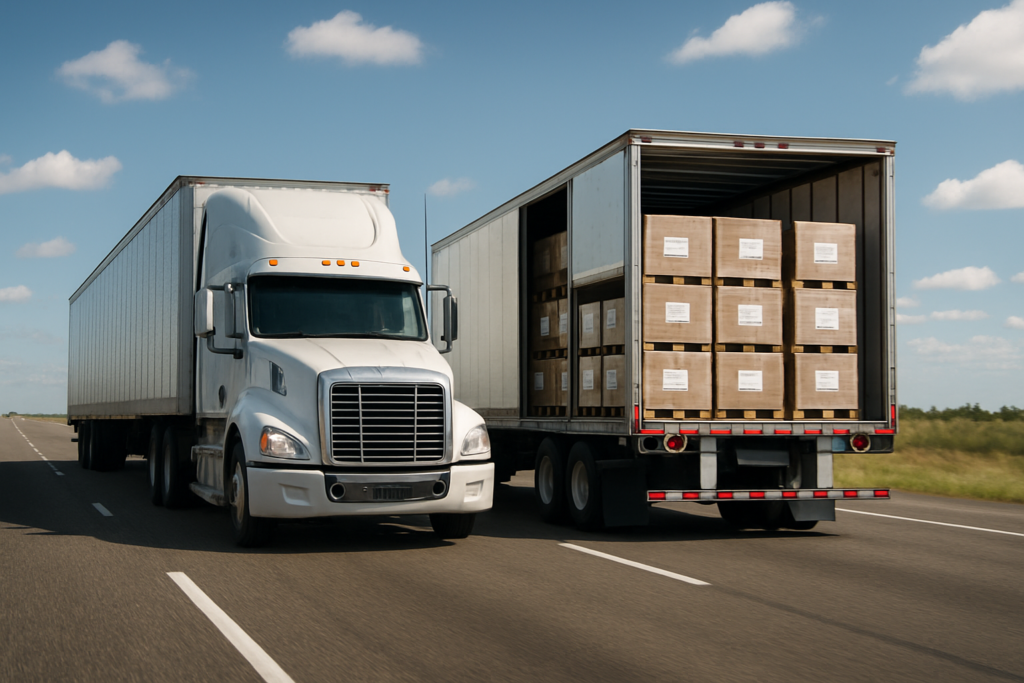
Full truckload (FTL) and less-than-truckload (LTL) freight are priced on entirely different structures. Choosing the wrong mode for your FTL vs LTL shipping cost analysis can mean overpaying by 30% to 50% on a cost-per-pound basis. Understanding where each mode becomes cost-effective is the fastest way to reduce your freight spend.
Table of Contents
- How FTL and LTL Rates Are Structured
- Current Rate Benchmarks for FTL vs LTL Shipping Cost
- The Weight Threshold That Determines Your FTL vs LTL Shipping Cost
- Hidden Cost Factors Most Shippers Overlook
- How a 3PL Can Reduce Your FTL vs LTL Shipping Cost
- Things to Know
Key Takeaways
- LTL rates are billed by weight, freight class, and density; FTL rates are billed by the mile per trailer.
- When freight falls below 10,000 to 12,000 lbs, LTL is almost always more cost-effective than booking an entire trailer.
- Current LTL contract rates average $46.40 per hundredweight (CWT), up 14.3% year-over-year as of Q1 2025.
- Shippers that force FTL on small loads routinely overpay by 30% to 50% on a cost-per-pound basis.
- Partnering with a 3PL gives you access to consolidated freight pricing that most shippers cannot negotiate independently.
- The U.S. LTL market generated $114 billion in 2024, signaling that most commercial freight moves this way for a reason.
How FTL and LTL Rates Are Structured
FTL pricing is straightforward. You pay for the entire trailer, typically billed per mile. Additionally, the carrier moves your freight directly from origin to destination with no intermediate stops. This approach reduces transit time and handling damage risk. That simplicity comes at a cost, because you pay for trailer space whether you fill it or not.
LTL pricing is considerably more complex. Carriers charge based on freight class (determined by density, stowability, handling, and liability), weight, and distance. Moreover, accessorial fees, fuel surcharges, and residential delivery charges layer on top. Because multiple shippers share trailer space, the carrier’s cost is distributed, making LTL economical for smaller loads.

Current Rate Benchmarks for FTL vs LTL Shipping Cost
According to Shipware, average LTL rates in 2024 ranged between $1.50 and $2.50 per mile. In contrast, FTL averaged $2.20 to $2.50 per mile. On a per-pound basis, Red Stag Fulfillment reports that the average cost per pound for LTL ranges from $0.15 to $0.75. Most shipments land between $0.22 and $0.42 per pound.
FTL vs LTL shipping cost analysis must also account for current market rates. LTL contract rates currently average $46.40 per CWT. This reflects a 14.3% increase year-over-year as of Q1 2025.
The LTL market is expanding rapidly. The U.S. LTL market generated $114 billion in 2024, according to industry data. Furthermore, the global LTL market is projected to reach $345.9 billion by 2033 at a CAGR of 5.90% (Emergen Research, 2024). Technavio projects the LTL segment will grow by an additional $119.6 billion between 2026 and 2030 at a CAGR of 6.9%.
These growth figures matter because increased demand pushes rates upward. LTL rates rose 5.4% year-over-year in May 2025. This continues a multi-year pattern of General Rate Increases from major carriers.
The Weight Threshold That Determines Your FTL vs LTL Shipping Cost
The practical rule for FTL vs LTL shipping cost decisions is weight. When freight falls below roughly 10,000 to 12,000 lbs, LTL pricing is almost always more cost-effective. You should avoid reserving an entire trailer. Above that threshold, or when you have time-sensitive, high-value, or fragile freight, FTL typically justifies the premium.
Shippers who ignore this threshold make costly mistakes. They default to FTL for smaller loads and routinely overpay by 30% to 50% on a cost-per-pound basis, according to Shipware. That margin represents significant waste, especially for businesses shipping multiple loads per week.
For shippers sitting near this threshold, exploring alternatives is worthwhile. Reviewing how freight consolidation 3pl efficiency works can help you find middle-ground solutions. These solutions avoid paying for empty trailer space.
Hidden Cost Factors Most Shippers Overlook
Several variables affect the final FTL vs LTL shipping cost beyond base rates.
Freight class matters significantly. Higher-class shipments cost substantially more per CWT in LTL settings. Accessorial fees add up quickly. Liftgate services, inside delivery, and residential surcharges layer costs on top. Transit time differs dramatically. LTL shipments make multiple stops, adding 1 to 4 transit days compared to direct FTL moves. Damage risk increases with handling. LTL freight is handled multiple times at cross-docks; FTL moves without intermediate handling.
Understanding cross docking vs traditional warehousing what businesses should know helps you evaluate whether cross-dock transit is a bottleneck. Alternatively, it may represent a cost-saving step in your supply chain.
How a 3PL Can Reduce Your FTL vs LTL Shipping Cost
A 3PL with established carrier relationships negotiates rates that individual shippers rarely access. At 3PL Warehouse By Best, serving the tri-state area of New York, New Jersey, and Connecticut, freight decisions integrate into the fulfillment process. For businesses exploring how 3pls support ecommerce order fulfillment at scale, consolidating outbound freight through a single 3PL often reduces both LTL and FTL rates. You achieve better pricing compared to managing carriers independently.
If you are not yet working with a reliable freight partner, taking action is smart. Reviewing the 20 best freight brokerage companies in 2026 and how to pick the right partner provides a practical starting point for carrier selection.
Things to Know
- LTL rates are calculated using freight class (NMFC), which means density directly impacts your final cost per pound.