
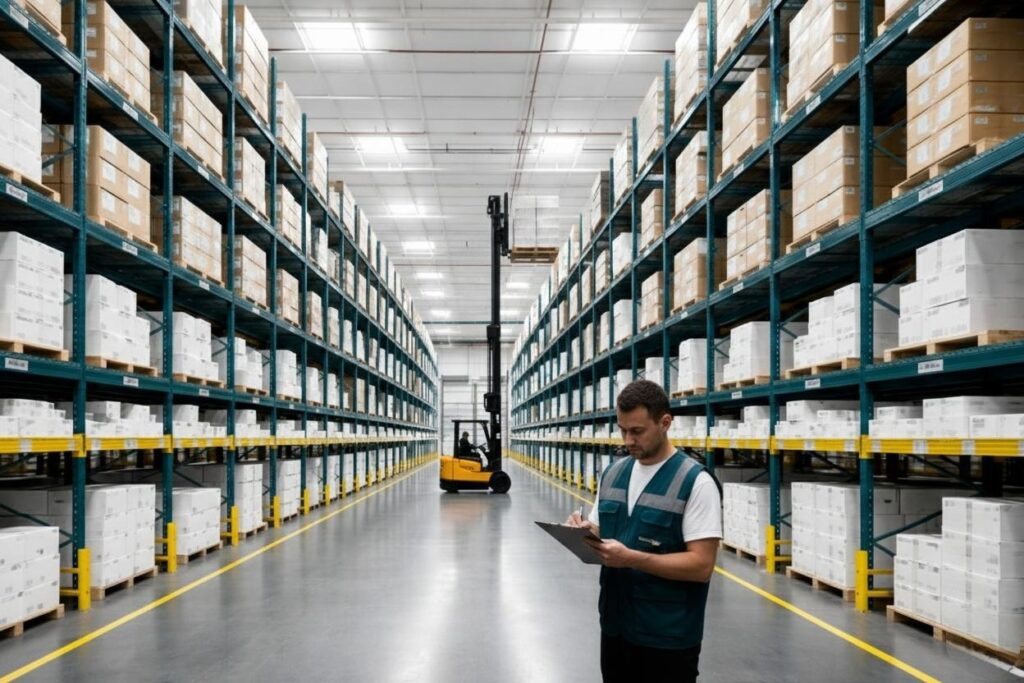
Modern 3PL warehouse services typically include storage and inventory management, order fulfillment (pick, pack, ship), transportation coordination, and reverse logistics for returns. These functions are increasingly tied together through a 3PL warehouse management system that provides real-time inventory and order visibility.
Inside This Guide
Fast Facts✔ Modern 3PL warehouse services bundle receiving, storage, inventory control, and order fulfillment under one operation. ✔ A 3PL warehouse management system (WMS) ties processes together with real-time inventory and order visibility. ✔ Transportation coordination supports predictable inbound arrivals and efficient outbound shipping execution. ✔ Reverse logistics and returns workflows protect inventory accuracy and speed up restocking decisions. ✔ Value-added services (kitting, labeling, light assembly) help meet channel requirements without adding in-house labor. |
Core Service No. 1: Receiving, Storage, and Inventory Management
Receiving is where errors often start, so modern 3PL warehouse management treats inbound as a controlled workflow. Typical steps include:
- Inbound scheduling: Appointments and documentation (often an ASN) so teams can plan labor and dock time.
- Receiving checks: Counts, damage inspection, and SKU verification.
- Putaway and slotting: Assigning inventory to bin locations based on velocity, size, or handling needs.
Storage options vary by product type. Many 3PL warehouse services support pallets, shelving, bins, and secured areas for higher-value items. If you are comparing 3PL warehouse solutions, ask how inventory accuracy is maintained. Common methods include cycle counting programs, exception reporting, and scan confirmation at key touchpoints.
Core Service No. 2: Order Fulfillment: Pick, Pack, and Ship
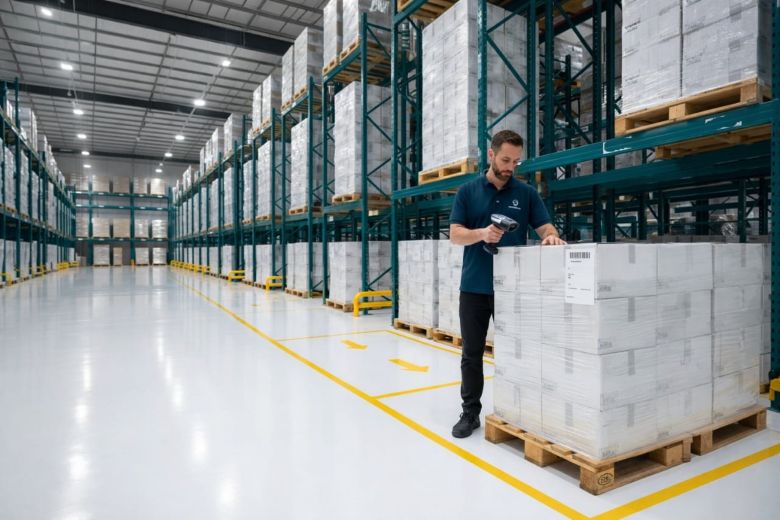
Order fulfillment is the most visible part of 3PL warehouse services, and it is usually built around scan-based accuracy. The standard flow looks like this:
- Order intake: Orders flow from ecommerce platforms or ERPs into the 3PL warehouse management system.
- Picking: Methods vary, but common approaches include single-order picking, batch picking, or zone picking based on SKU count and volume.
- Packing: Right-size cartons, protective materials, inserts, and packing documentation as required.
- Shipping handoff: Label generation, carrier handoff, and end-of-day manifests.
A modern 3PL warehouse manager typically designs the pick paths, packing rules, and quality checks to reduce mis-picks and shipping errors. Businesses evaluating 3PL warehouse management should ask how errors are prevented, not just how they are corrected. Scan verification at pick and pack, pack audits, and exception queues are common controls.
Core Service No. 3: Transportation Coordination (Inbound and Outbound Logistics)
Transportation coordination is often included as a layer around fulfillment. A 3PL warehouse may not operate trucks directly, but many coordinate key pieces of movement and carrier execution:
- Inbound freight coordination: Scheduling, delivery appointments, and basic freight planning so inventory arrives predictably.
- Outbound shipping strategy: Helping businesses route shipments through parcel, LTL, or full truckload based on order profile.
- Carrier execution support: Label creation, tracking events, and documentation needed for pickups.
For businesses operating in dense markets, 3PL warehouse in New York City often includes practical constraints: delivery windows, limited-access locations, and higher likelihood of accessorials. The more the 3PL warehouse manager understands metro-area carrier behavior, the smoother the shipping handoff tends to be.
Core Service No. 4: Reverse Logistics (Returns) and Disposition Workflows
Returns are not a side task anymore. In 2023, the total retail return rate was 14.5% of sales, which makes returns processing an important part of modern 3PL warehouse services.
Typical return steps include:
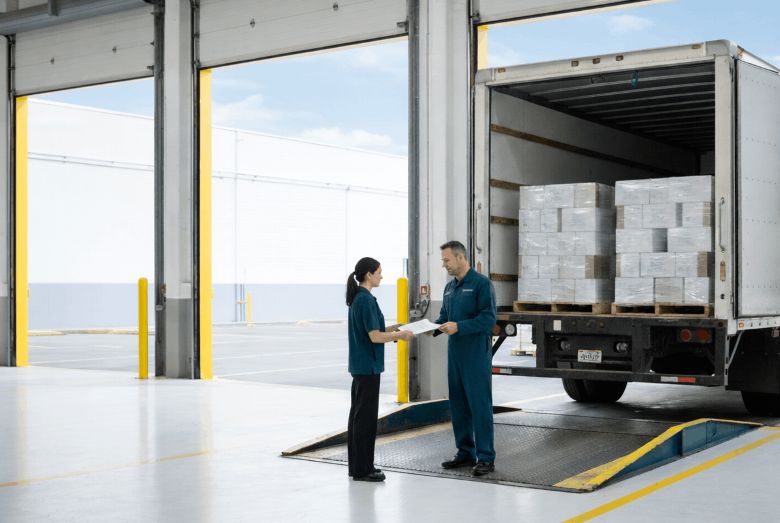
- Receiving and inspection: Confirm the item and condition; capture damage reasons when possible.
- Disposition decisions: Restock, quarantine, refurbish, repackage, recycle, or destroy based on policy.
- Inventory updates: Return outcomes updated inside the 3PL warehouse management system to prevent phantom stock.
Businesses should evaluate how detailed the returns workflow is. Some 3PL warehouse solutions only receive and segregate returns, while others can test, repackage, and restock quickly.
Value-Added Services (VAS): What “Extras” Modern 3PLs Provide
Value-added services are the “custom work” layer that helps businesses meet channel requirements, improve presentation, or handle unique product needs. You will often see this described as value added services 3PL warehouse options.
Common examples include
- Kitting: Bundling multiple SKUs into a single sellable unit.
- Custom labeling: Retail labels, carton labels, or compliance labels required by specific channels.
- Light assembly: Simple product assembly, inserts, or multi-part set builds.
- Repackaging: Reboxing, polybagging, or prepping products for retail presentation.
- Quality checks: Inspections for specific defect criteria or compliance rules.
These services matter because they can prevent downstream issues. A value added services 3PL warehouse program can reduce chargebacks in wholesale, improve unboxing consistency in direct-to-consumer, and speed up promotions that require bundles.
Who Runs It Day to Day? The Role of a 3PL Warehouse Manager
A 3PL warehouse manager is usually responsible for execution quality and operational planning. If your business is evaluating 3PL warehouse services, this role often determines how consistent the experience will be over time.
Common responsibilities include:
- Labor and workflow planning: Staffing inbound and outbound based on volume patterns.
- Process control: Enforcing SOPs for receiving, picking, packing, and returns.
- Quality management: Audits, scan compliance, and corrective action on error trends.
- Exception handling: Resolving inventory discrepancies, damages, and shipment issues.
- KPI reviews: Reporting on order accuracy, timeliness, and inventory health.

Frequently Asked Questions (FAQs)
What is a full-service 3PL?
A full-service 3PL handles end-to-end logistics, including storage, inventory management, order fulfillment (pick/pack/ship), transportation coordination, and returns, often supported by a 3PL warehouse management system (WMS).
How does a 3PL warehouse work?
A 3PL warehouse receives your inventory, stores it, tracks it in a WMS, and fulfills orders by picking, packing, and shipping. Many also handle returns and value-added services like kitting or labeling.
What is the difference between a warehouse and a 3PL?
A warehouse typically provides storage space. A 3PL provides storage plus operations, including fulfillment labor, shipping coordination, technology, and broader 3PL warehouse management.
What are some common 3PL challenges?
Common challenges include inventory inaccuracies, slow communication, integration issues, unexpected fees, service level inconsistencies during peak season, and limited visibility into order and inventory status.
What are the three major operations of logistics?
The three major logistics operations are inbound logistics (receiving goods), warehousing and inventory management (storage/control), and outbound logistics (order fulfillment and delivery).
Talk to 3PL Warehouse By Best About Modern 3PL Warehouse Solutions
For businesses looking for a 3PL warehouse in New York City, it can also help to discuss your delivery constraints, peak season needs, and any value added services 3PL warehouse work such as kitting, custom labeling, or light assembly.
3PL Warehouse By Best in NYC supports businesses with modern 3PL warehouse services and scalable 3PL warehouse management. We can also help identify process bottlenecks in your current fulfillment flow and recommend practical ways to improve speed, accuracy, and inventory visibility.